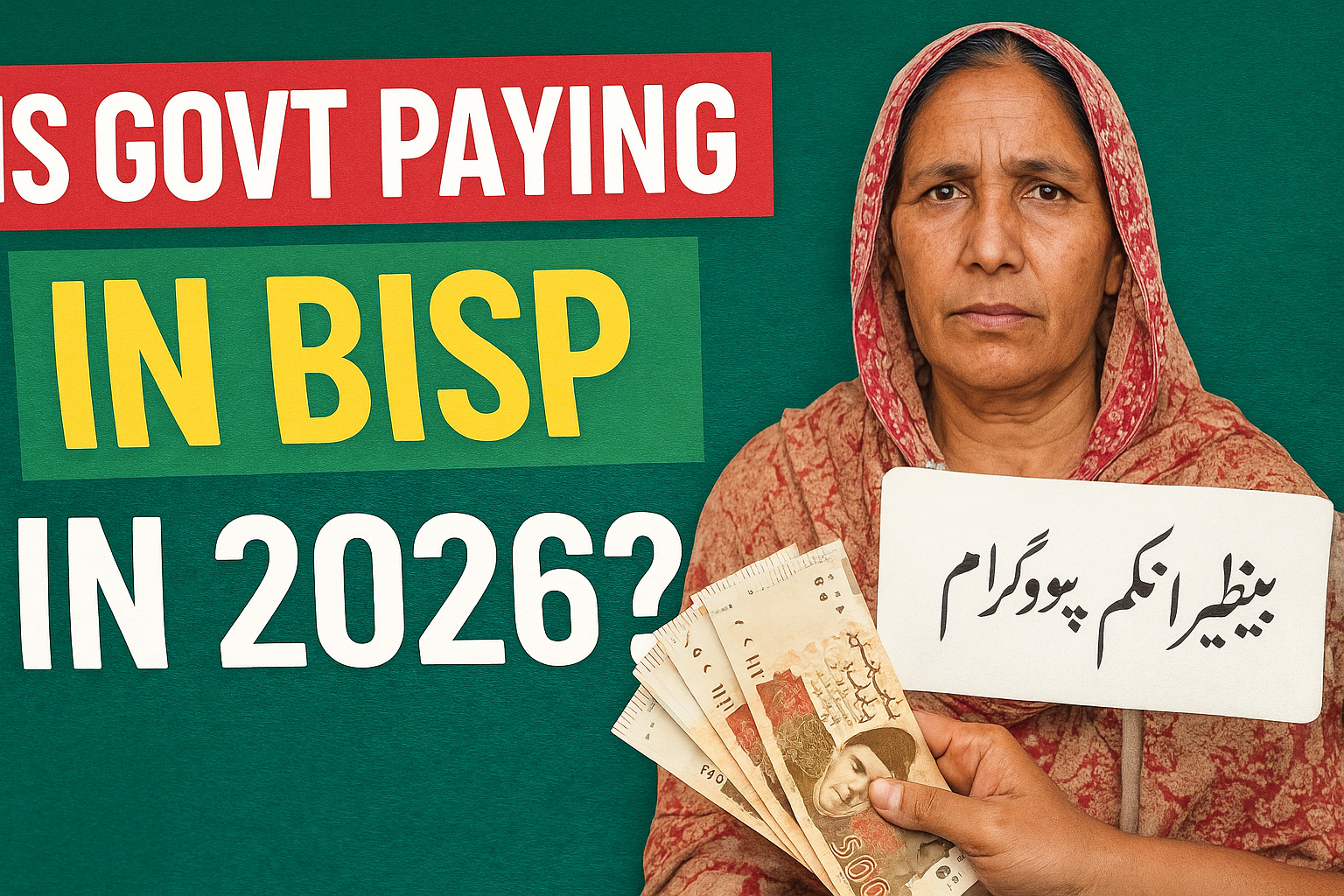
The social welfare landscape in Pakistan often generates questions like — “Is the government really paying families under BISP in 2026?” The short answer: yes — the government, through BISP, continues to pay eligible beneficiaries, but there are updated rules, amounts, and verification requirements you should know. This article unpacks the latest status as of late 2025 / early 2026, what you (or your family) need to have in place, and how to check or claim payments.
📌 What is BISP and Who It Helps
-
BISP is a government cash-transfer programme aimed at providing financial assistance to low-income households, especially women, to help them meet basic needs such as food, education, and healthcare
-
According to recent data, around 10 million families nationwide are beneficiaries under BISP.
-
The programme has undergone reforms: modernized registration through updated socioeconomic surveys (like the National Socio-Economic Registry, NSER), biometric verification, and improved payment delivery systems.
Thus, BISP remains the main social safety net in Pakistan, especially for women-headed households and vulnerable families.
✅ Are Payments Ongoing in 2025–26?
Yes — the payments under BISP are currently active and being disbursed. Some key recent developments:
-
As of late 2025, the authorities confirmed payments are continuing as per normal schedule; there is no suspension or halt.
-
Many beneficiaries — about 80% in recent cycles — are now receiving payments directly to bank accounts rather than needing to visit physical campsites.
-
Payment methods now include bank ATMs, partner banks, and in some cases mobile/digital-wallet disbursement, improving accessibility and reducing long lines. For families previously excluded (due to data mismatches, expired CNICs, or other issues), many have now been reactivated after verification — the government says it has “restarted payments for old beneficiaries.”
Conclusion: If your household qualifies and has an updated record, BISP payments are indeed being made in 2025–26.
💵 What is the Payment Amount in 2026?
The payment amount under BISP has been recently adjusted to account for inflation and changing economic conditions:
-
Historical BISP quarterly installments were Rs 13,500 for many beneficiaries.
-
Recent updates indicate that from January 2026, the new quarterly stipend will be Rs 14,500.
-
The reasons given for this increase include inflation adjustment and the government’s desire to maintain beneficiaries’ purchasing power.
Thus, for eligible families, BISP continues not only to pay but to slightly increase support as of 2026.
📄 Who Qualifies — Eligibility & Verification in 2026
However, payments are not automatic for everyone. To receive BISP support in 2026, you must meet certain conditions:
| Requirement | Details / Notes |
|---|---|
| Valid registration & survey data | Households must be registered under BISP and included in NSER (or other updated survey databases). |
| Updated CNIC / valid identity documents | CNIC (or spouse’s CNIC, children’s B-Forms if applicable) must be valid, and biometric verification may be required. |
| PMT (Poverty Means Test) score under threshold | Only households deemed poor under PMT criteria remain eligible. |
| No disqualifying income/assets | Households with government employees, pensioners, or those with high assets or certain luxury assets may be disqualified (as per original BISP rules). |
| Respond to dynamic survey if asked | Some beneficiaries must complete a “dynamic survey” to verify that their income or household status hasn’t improved fraudulently. |
In short: if you qualify under these criteria and your information is up-to-date — valid CNIC, poverty score, etc. — then you should continue to receive payments.
📲 How to Check Your Payment / Stay Updated
If you want to confirm whether you’re getting payments, or check when payments are due, here’s how:
-
Send your CNIC number via SMS to 8171 — this is the official BISP short code for status checking.
-
Use the official BISP web portal (often referred to as “8171 portal”) to check eligibility and payment status online.
-
Some beneficiaries now receive payment directly through bank accounts or digital wallets, meaning you may see the funds in your account rather than needing to visit a payment camp.
-
If there were previously payment suspensions (due to expired documents or survey data issues), contact your local BISP tehsil office or NADRA for re-verification. Many had payments restored in 2025.
⚠️ What Changed Recently — What to Watch Out For
While BISP continues, there are some important updates and changes:
-
The quarterly installment has changed (rising to Rs 14,500 starting January 2026) — good news, but only for those whose records are complete and verified.
-
Not all beneficiaries from previous years automatically continue — those who did not complete required verification (dynamic survey, updated CNIC, etc.) may lose eligibility.
-
The shift from cash-camps to bank or digital payments is ongoing; those unfamiliar with bank/ATM/digital wallets may face difficulties withdrawing funds, especially in remote areas.
-
Some households may be excluded due to improved financial situations, new income sources, or disqualifying assets — so BISP is actively re-evaluating beneficiaries to keep the support focused on the most needy.
📝 What This Means for People in 2026 — Especially in Places Like Sindh / Rural Areas
For many families, especially in rural areas or poorer districts (like Sindh, where you are), this continuation of BISP payments is a critical support — especially against inflation, rising cost of living, and economic uncertainty.
But to benefit:
-
Make sure your CNIC and household data are valid and updated
-
If you were a previous beneficiary and stopped receiving payments, check whether you need to re-verify or respond to a survey
-
Use official channels (SMS 8171 or the 8171 portal) to check payment eligibility
-
If possible, request payment into a bank account or digital wallet for easier access — helps avoid long travel to campsites
For many vulnerable families, the improved stipend (Rs 14,500/quarter) can make a difference in buying essentials, paying school fees, or handling health expenses.
✅ Final Words: Yes — but Stay Alert & Verified
In short, the government is paying the public via BISP in 2026, provided eligibility and verification criteria are met. The programme remains active, payment amounts have increased, and payment delivery has been modernized.
If you or someone you know relies on BISP support — it’s a good time to check your status via SMS or the official portal. Stay up to date with CNIC, survey, and banking information.